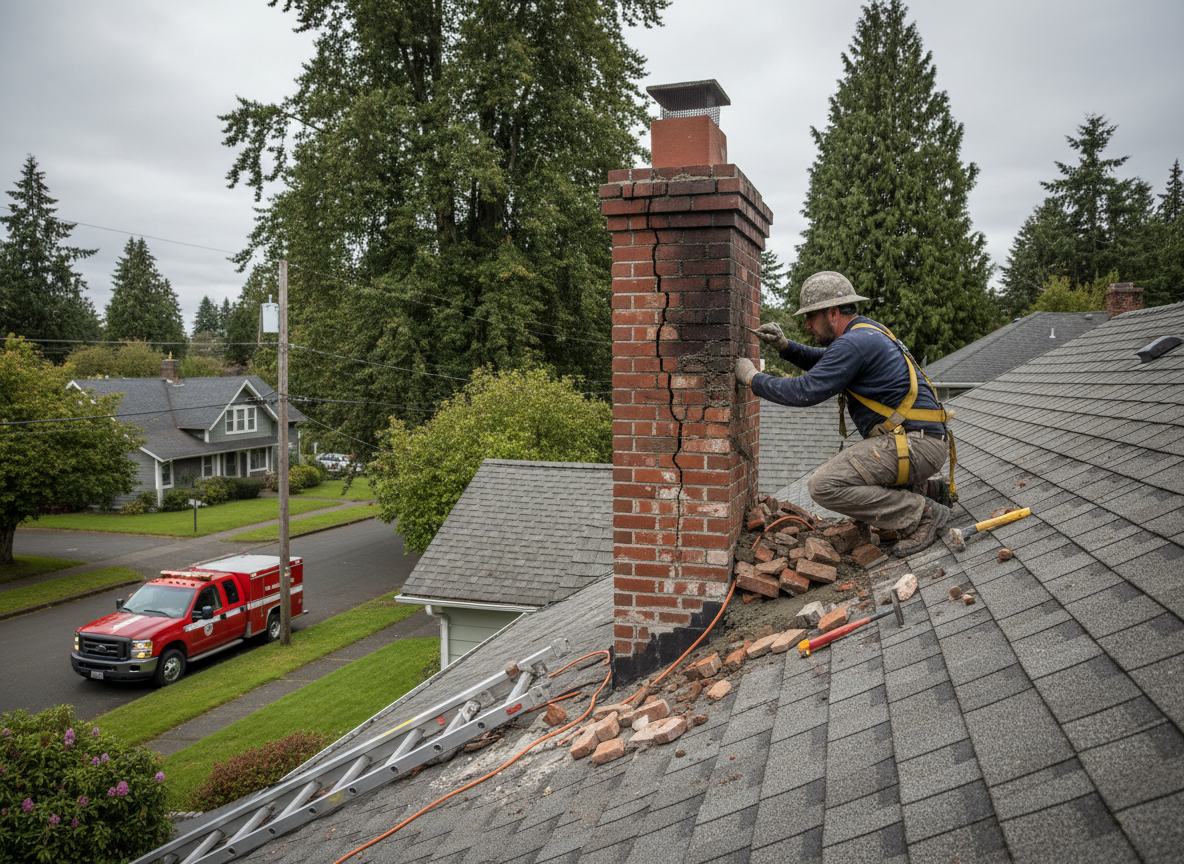
Gresham sits in Multnomah County where wet winters bring repeated rain and occasional flooding that drives water into chimney crowns and flue liners. Older homes near Gresham Pioneer Cemetery and in Rockwood often have single-wall masonry that absorbs moisture during mild summers then spalls when temperatures swing. Emergency calls spike after storms when water reaches the smoke chamber and weakens the bond between flue tiles and brick. DraftSafe Masonry keeps crews on call from the shop at 1005 N Main Ave, Unit 101 so we can reach a leaking stack before the next front rolls in from Portland.
Terrain around Mt. Hood Community College slopes toward low spots that collect runoff, pushing water against foundation walls and up into chimney bases. In these conditions a small crown crack turns into full liner separation within one season. We carry stainless-steel sleeves and refractory mortar sized for the common 8-by-8 and 13-by-13 flues found in 1960s–1980s Gresham tract houses. Every emergency job starts with a camera sweep from the roof down to confirm the water path before any material is ordered.
Code work in Multnomah County requires spark arrestors and proper flashing height above the roof plane. When flooding has already saturated the chase, we add weep holes at the base so trapped water can exit instead of freezing and cracking new mortar. Homeowners in Downtown Gresham call after noticing white efflorescence on interior brick; that staining signals ongoing moisture that will destroy the flue if left through another winter.
Technician insight
In Gresham the thing that catches most people out with emergency chimney repair is how fast water from wet winters travels down the flue and saturates the single-wythe brick common in Rockwood homes. Homeowners see a little white powder on the interior and think it is just cosmetic, but that efflorescence means the mortar is already softening. Once the next flood event hits, the chase fills and the only fix left is a full liner pull.
Rockwood Chimney After December Storm
Water poured down the flue during a heavy rain and pooled at the smoke chamber of a 1978 split-level near 181st. Camera showed separated tiles and saturated brick at the base. We installed a stainless sleeve, rebuilt the crown with a positive slope, and added weep holes so future runoff could escape instead of freezing inside the chase.
How it works
- 1
Initial Call and Dispatch
Answer within minutes, confirm location in Gresham or Rockwood, and roll a truck from 1005 N Main Ave.
- 2
On-Site Safety and Assessment
Secure the roof access, run a camera inspection, and mark water entry points before any repair begins.
- 3
Temporary Weatherproofing
Install a rain diverter or temporary cap to stop additional water while permanent materials are staged.
- 4
Permanent Repair and Verification
Rebuild crown, sleeve the flue if needed, reflash to roof, then test draw with a smoke bomb before leaving.
Pricing
Upfront quotes after inspection, billed by scope rather than flat rate.